Distance To The Horizon

Astro Navigation Demystified

Pythagoras provides us with a method calculating the distance to the horizon.

In the diagram below,

A represents a ship’s position.

B is the top of the lighthouse.

Bis the base of the lighthouse.

C is the Earth’s centre.

r is the radius of the Earth.

h is the height of the lighthouse.


By Pythagoras:

AB2  =  CB2 – AC2

→      AB2  =  (r + h)– r2

→      AB2  =  2rh + h2

→      AB   =  √(2rh + h2)

(Note. hcan be discounted since r is many, many times greater than h).

So the formula for calculating the distance from the top of an object to the horizon becomes:  √(2rh)

 Example.  Calculating the distance to an object on the horizon.

In the following example, we will imagine that the Pharos Lighthouse (ht. 120m.) is the object in question.

Note.  Since the heights of objects marked on modern navigational charts are usually given in metres, it would be easier to calculate the distance in kilometres instead of nautical miles.

Since we know that the mean radius of the Earth is 6367.45 Km. and the height of the Pharos light was 120m. we can put these values into the formula √(2rh) as follows:

Distance =√ (2×6367.45 x 120/1000)  (divide h by 1000 to convert to Km.)

= √(12734.9 x 0.12)

= √1528.18

= 39.09 Km.

To convert to nautical miles:  1 nautical mile = 1.85 Km. so, if we want to convert the answer to nautical miles, we must divide by 1.85.  (In fact, it is easier to multiply by 0.54 which is the inverse of 1.85). Thank you David Cooper).

So the answer to the above example in nautical miles becomes: 39.09 x 0.54 = 21.1 n.m.

 Therefore, assuming the observer is at sea level, the top of the lighthouse would become visible at a distance of 39.09 Km. or 21.1 n.m.

Summary of Formulas for finding the distance from the top of an object to the horizon, :

D =  √(2rh)

D = √(12734.9 x h/1000) Km.

D = √(12734.9 x h/1000) x 0.54 n.m.

What about the height of eye?   The above calculation was made with the assumption that the observer’s eye is at sea level.  Of course, the height of the observer’s eye will be several metres above sea level (say 3 – 4 m. in a yacht or small fishing vessel).  So the height of eye must obviously be taken into account and the problem now becomes as shown in the following diagram:
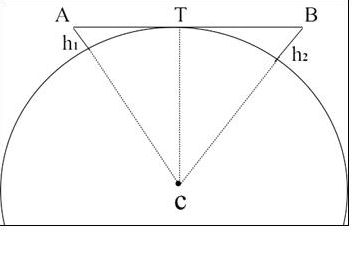
A represents the observer,

B represents the top of the lighthouse,

T represents the horizon,

h1 represents the observer’s height of eye (say 4m.)

h2 represents the height of the lighthouse (120m.).

So, we have  AB  =  AT + BT

To calculate the value of AB, we must first calculate the values of AT and BT.

Using the formula that we previously established for finding the distance from the top of an object to the horizon, we have:

AB  = √(2rh1) + √(2rh2)

Given that r = 6367.45 Km.   h= 4m.   and h= 120m.

we have:

D = (2 x 6367.45 x h1/1000) + (2 x 6367.45 x h2/1000)  Km.

(12734.9 x 4/1000) + (12734.9 x 120/1000)  Km.

(12734.9 x 0.004) + (12734.9 x 0.12)  Km.

= 7.1 + 39.09 Km.

=  46.19 Km.

To convert to nautical miles, we have:

D   = 46.19 x 0.54 = 24.9 n.m.

So we can see that taking the observer’s height of eye into account makes quite a difference to the result.

Summary of formula for calculating the distance that an object will appear on the horizon taking into account height of eye:

D = √(2rh1) + √(2rh2)

D = (12734.9 x h1/1000) + (12734.9 x h2/1000)  Km.

Or   D = (12734.9 x h1/1000) + (12734.9 x h2/1000)  x 0.54 n.m.

 What about the height of tide?

The height of objects shown on navigational charts is the height above the level for ‘mean high water springs’ (MHWS) which is used as the chart datum for heights.  When navigating in areas where there is a large tidal range, the height of tide in relation to MHWS must be taken into account if the charted height of the object is being used in navigational calculations.  For example, in the vicinity of the Channel Islands, the height of tide at low water springs can be in the region of 7.5 metres below the level for MHWS and in such circumstances, 7.5 metres would obviously need to be added to the charted heights of objects.

Revise Pythagoras

A fuller explanation of this topic is given in ‘Astro Navigation Demystified’

Astro Navigation Demystified on Amazon

web: www.astronavigationdemystified.com

Posted in Uncategorized | Leave a comment

Survival – Calculating Altitude Without An Angle Measuring Instrument

Links:  Astro Navigation in a survival situation.    Latitude from the midday Sun.    Find your longitude.     Calculating declination.    Declination table.     Trig table.    Revise trigonometry  Revise Spherical Trigonometry

As the above links demonstrate, there are several methods of employing astro navigation to calculate your position in a survival situation.  The crucial data that is required for these methods is the altitude of a celestial body such as the Sun.

In an ideal situation, we would use a sextant or similar angle measuring instrument to measure the altitude of an object but obviously in a survival scenario it is highly unlikely that we would have access to such heavy, cumbersome and expensive equipment.  However there is a method that enables us to calculate the altitude without actually measuring the angle.

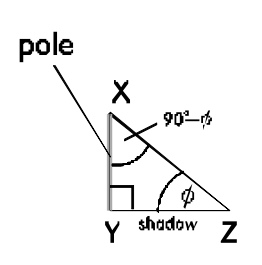
To understand the method, we need to think about the simple ‘shadow-stick’ experiment which is often practised in school maths lessons.  As shown in the diagram below, if we put an upright pole in the ground when there is bright sunlight, the pole, a ray of sunlight and the pole’s shadow give a right-angle triangle in which, angle ø is equal to the altitude of the Sun.

shadow stick


If we measure the height of the pole and the length of its shadow, we will have the lengths of two of the sides of the triangle and these are respectively the opposite and adjacent sides to the angle ø.  The opposite side divided by the adjacent side will give us the tangent of angle ø and the inverse of the tangent will be equal to the altitude of the Sun.

For example, if the height of the pole is 1.5 metres and the length of the shadow is 2.3 metres, we can calculate the altitude as follows:

Tangent(altitude) = 1.5 / 2.3 = 0.65

Using the trig tables, we see that the inverse of tangent 0.65 = 33o.

So the altitude is 33o.

Practical Examples:

Example 1.  Calculate your latitude.

Scenario:   Date: 20 November.   Location:  Lost somewhere in the Sahara Desert (possible latitude 15o to 30o north).

At noon, you calculate your latitude by the following method:

Step 1.  You place a straight stick in the ground making it as upright as possible.

Step 2. You measure the height of the top of the stick above the ground and find it to be 0.9 metres.

Step 3.  You use a magnetic compass to check the direction of the stick’s shadow at frequent intervals until it bears north.  At this point, it will be noon.

Step 4.  You measure the length of the shadow and find it to be 0.8 metres.

Step 5.  You calculate the altitude as follows:  Tan (altitude) = 0.9 / 0.8  =  1.125

Inverse of  tangent 1.125 = 48.36o.

Therefore altitude = 48to the nearest whole degree.

Step 6.  You look up the Sun’s declination for 20 November and find it to be 19.6south

Step 7.  You calculate the latitude as follows:   You know that the Sahara is in the northern hemisphere and that in November, the Sun is over the southern hemisphere.  So the formula for calculating the latitude when latitude and declination are in opposite hemispheres is:  LAT  =  (90o – ALT) – DEC  so, using the measurements above, the calculation becomes:     Latitude = (90 – 48) – 19.6  = 22.4 north.

Example 2. Calculate your latitude and longitude by the methods shown here: latitude     longitude

Scenario:  Date: 30 September   Location:  Shipwrecked on the west coast of Namibia. (18o to 28o south and 13o to 17o east).

Task 1 – Calculate Latitude.

Step 1.  You place a pole in the ground making it as upright as possible.

Step 2. You measure the height of the top of the pole above the ground and find it to be 3.6 metres.

Step 3.  Using a magnetic compass, you keep checking the direction of the stick’s shadow until it bears north.  At this point, it will be noon.

Step 4.  You measure the length of the shadow and find it to be 1.2 metres.

Step 5.  You calculate the altitude as follows:  Tan (altitude) = 3.6 / 1.2  =  3.0

The inverse of  tangent 3.0 is 71.56o.

Therefore altitude = 71.5to 1 d.p.

Step 6.  You look up the Sun’s declination for 30 September and find it to be 2.6south

Step 7.  You calculate the latitude as follows:   You know that the latitude of Namibia is in the region of 17south and that declination is 2.6south. So the formula for calculating the latitude when declination and the approximate latitude are in the same hemisphere but the approximate latitude is greater than the declination, is as follows:

LAT  =  DEC + (90o – ALT)   

Using the measurements above, the calculation becomes:  Latitude = 2.6 + (90 – 71.5) = 21.1

So latitude is 21o south to the nearest degree.

Task 2 – Calculate Longitude .   One of the survivors has a wrist watch which is still in working order.  The watch would have last been set to the zone time kept by the ship before it was wrecked.  Since the ship was travelling down the west coast of Namibia its longitude would have been approximately 13o east so the zone time would have been -1.

Step 1.  Calculate GMT.    At the same that the shadow stick indicates that it is noon local time, you check the zone time on the watch and find it to be 12.08 p.m.  So you calculate GMT as follows:  GMT = zone time – 1  = 12.08 – 1 = 11.08

Step 2.  Calculate time difference.  You have calculated that at noon local time, it is 11.08 GMT so the time difference is 52 minutes.

Step 3.  Calculate difference in longitude between the Greenwich Meridian and your position.  You know that in 1 hour, the Sun moves 15o  so in 52 minutes the difference in longitude will be  (52/60) x 15 = 13o.

Step 4.  Calculate longitude of your position.  Using the rule GMT Least, Longitude East, you calculate that your longitude is 13o East.

Therefore, your latitude and longitude are 21o south, 13o east.

It could be reasonably be argued that just as a sextant is not likely to be in the possession of someone in a survival situation, neither are a ruler, a calculator and an almanac.  However, a typical survival kit includes a compass, map, matches, first-aid pack, water etc.   It would make sense to include a small tape-measure and two printed pages containing trig ratios such as this and the Sun’s declination such as this.  These three small items are all that are required to calculate the altitude of the Sun using the method described above.  (If a straight pole cannot be found the shadow cast by an upright person would do just as well).

A fuller explanation of this topic is given in the books ‘Astro Navigation Demystified’  and ‘Applying Mathematics to Astro Navigation’.
Astro Navigation blog:  Astro Navigation Demystified.

web: www.astronavigationdemystified.com


Posted in Uncategorized | Tagged , , , | Leave a comment

The Relationship Between Altitude and Zenith Distance

fullkindlecover3Several readers have raised questions relating to my post dealing with the Intercept Method.  These questions mostly concern the relationship between altitude and zenith distance and also the relationship between angular distance and the nautical mile.

Since several chapters of my book Astro Navigation Demystified are devoted to answering these questions, it is very difficult to cover them in one relatively short post.  However, the following attempts to provide the answers in as concise manner as possible.

The Relationship Between Altitude and Zenith Distance.  We usually consider azimuth and altitude from a position on the surface of the Earth.  To fully understand how these phenomena relate to the LHA and declination of a celestial body and hence, how they help us to establish our position, we need to consider them in relation to the celestial sphere.

Consider the following diagram.

diag23new drawing3

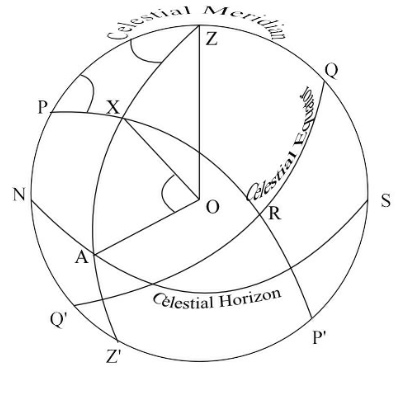
The celestial sphere is drawn in the plane of the observer’s meridian with the observer’s zenith (Z) at the top.

Point O represents both the observer and the Earth.

The arc PZQSP’ represents the observer’s celestial meridian.

The arc NAS is the celestial horizon and QRQ’ represents the celestial equator.

ZXAZ’ is a vertical circle running through the position of the celestial body (X).  (A vertical circle is a great circle that passes through the observer’s zenith and is perpendicular to the celestial horizon).

 The Altitude is the angle AOX in the diagram; that is the angle from the celestial horizon to the celestial body measured along the vertical circle.

The Zenith Distance is the angular distance ZX measured along the vertical circle from the zenith to the celestial body; that is the angle XOZ.

 Since the celestial meridian is a vertical circle and is therefore, perpendicular to the celestial horizon, it follows that angle AOZ is a right angle and angles AOX and XOZ are complementary angles.  From this we can deduce that:

         Zenith Distance = 90o – Altitude

and   Altitude = 90o – Zenith Distance

Therefore, if we calculate the altitude at the assumed position and at the same time, we measure the altitude at the true position, then we can calculate the intercept as follows:

 Zenith Distance at true position = 90o –  measured altitude

Zenith Distance at assumed position = 90o –  calculated altitude

Intercept = Zenith Distance at true position  ∆ Zenith Distance at assumed position

Expressing the Angular Distance of  the Zenith Distance in terms of Nautical Miles.  Refer to the diagram below.

diag3

Angle ZPX is the local hour angle and side ZX is the angular distance subtended by angle ZPX.  So, if the hour angle is 10o, the angular distance ZX will be 10 x 60 minutes of arc and since 1 minute of arc subtends a distance of 1 nautical mile on the Earth’s surface,  ZX will be 600 nautical miles in this case.

A fuller explanation of this topic is given in the book ‘Astro Navigation Demystified’.

Astro Navigation blog:  Astro Navigation Demystified.

web: www.astronavigationdemystified.com

Posted in Uncategorized | Leave a comment

Zone Time

AND1It would be impossible for a ship at sea to keep to the time of its longitude because (unless it is travelling due north or south) the longitude will be constantly changing.  For this reason, the sea areas of the Earth are divided into time zones which are 15O  (or 1 hour) apart.   The central meridian of each zone is an exact number of hours distant from the Greenwich meridian so that zone time differs from GMT by multiples of 1 hour.  The time kept in each zone is the time of its central meridian and is plus or minus GMT depending on the zone’s position east or west of Greenwich.

 Time Zone System.  The Earth is divided into 24 zones of 15of longitude each, with the centre of the system being the Greenwich meridian.  Therefore, the centre zone (zone 0) lies between 7.5W. and 7.5E.   The zones lying to the West of Greenwich are numbered from +1 to +12 and those to the East from -1 to 12.  The 12th zone is divided by the meridian 180which is known as the International Date Line.  The two halves of the 12th zone are marked + or – depending on which side of the date line they lie.

The following table shows the centre meridian of each of the 24 time zones. It should be remembered that each zone is 15wide and extends 7.5O either side of its centre meridian.  Thus, since the centre meridian of zone +4 is 60OW, it’s limits are 52.5OW to 67.OW.

time zone

 To Convert Zone Time to GMT.  The time kept in zone 0 is GMT.  To convert any other zone time to GMT, simply apply the sign and number of the zone to the zone time.  For example, if it is 1800 in zone +5, GMT will be 2300.

The Greenwich Date (G.D.) is obtained by converting the zone time and date to GMT

Example 1:  ZT 0230(-8), 15 Apr

GD = ZT – 8   = 1830, 14 Apr.

Example 2:  GD 0515, 25 Dec.

ZT(+10) = GD – 10  = 1915, 24 Dec

Exercise Questions

 Question 1.  A ship’s longitude is 35O,36’.5W.  If GMT is 3h 35m 12s what is zone time?

 Question 2.  On 5 July, a ship’s longitude is 145O, 15’.33E.  If zone time is 3h 20m 30s, what is the Greenwich Date?

Question 3.  A ship’s longitude is 158O, 2’.38E.  If the GD is 2330 3 July, what is ZT?

Question 4.  At GD = 12h 01m, 30th. April, what is the zone time for a ship in position Latitude 0O, longitude 179O,59’.9E ?

Question 5. At GD = 11h 59m , 30 April, what is the zone time for a ship in position Latitude 0O, longitude 179o,59’ W ?

Question 6. Approximately how far apart in geographical miles are the two ships in questions 4 & 5 at GD 12h 00m 30 April?

(Note. The international geographical mile (g.m.) is a unit of length determined by 1 minute of arc along the Earth’s equator and is defined as 1855.32m.).

 Click here for answers to exercise questions.

 A fuller explanation of this topic is given in the book ‘Astro Navigation Demystified’.

Useful Link:  The Sun as a time keeper.

Home:  www.astronavigationdemystified.com

Posted in Uncategorized | Tagged , , , | Leave a comment

Lunar Distance


With the invention of the chronometer in 1759, mariners were, for the first time, able to calculate longitude by finding the difference between Greenwich Mean Time and Local Time.  However, the marine chronometer did not become affordable until around 1850 and so they were not widely used until about that time.  It would seem therefore that, for most of the 18th. and 19th. centuries, those mariners who were unable to obtain a chronometer would be unable to calculate their longitude.  However, there are other methods of calculating longitude which do not rely on the use of a chronometer and one of those that was widely used until the late 19th. century was the method of Lunar Distance.

Method.

The Moon completes an orbit of the Earth in 27.3 days, moving from West to East.  Therefore, in one day it will move 13o.18with respect to the Sun, the stars and planets.  So, in one hour it will move 0.55and in 1 minute it moves 0.009o.  These figures are approximated in the following table:

The Moon moves:

13o  in 1 day.

0.5o  in 1 hour.

0.01o  in 1 minute.

This should not be confused with the fact that, as the Earth revolves about its own axis from West to East, the celestial bodies that are visible in the sky, including the Sun and the Moon, will appear to move in the opposite direction i.e. from East to West at an approximate rate of 15o of longitude per hour.  Click here for a fuller explanation of this.

Method

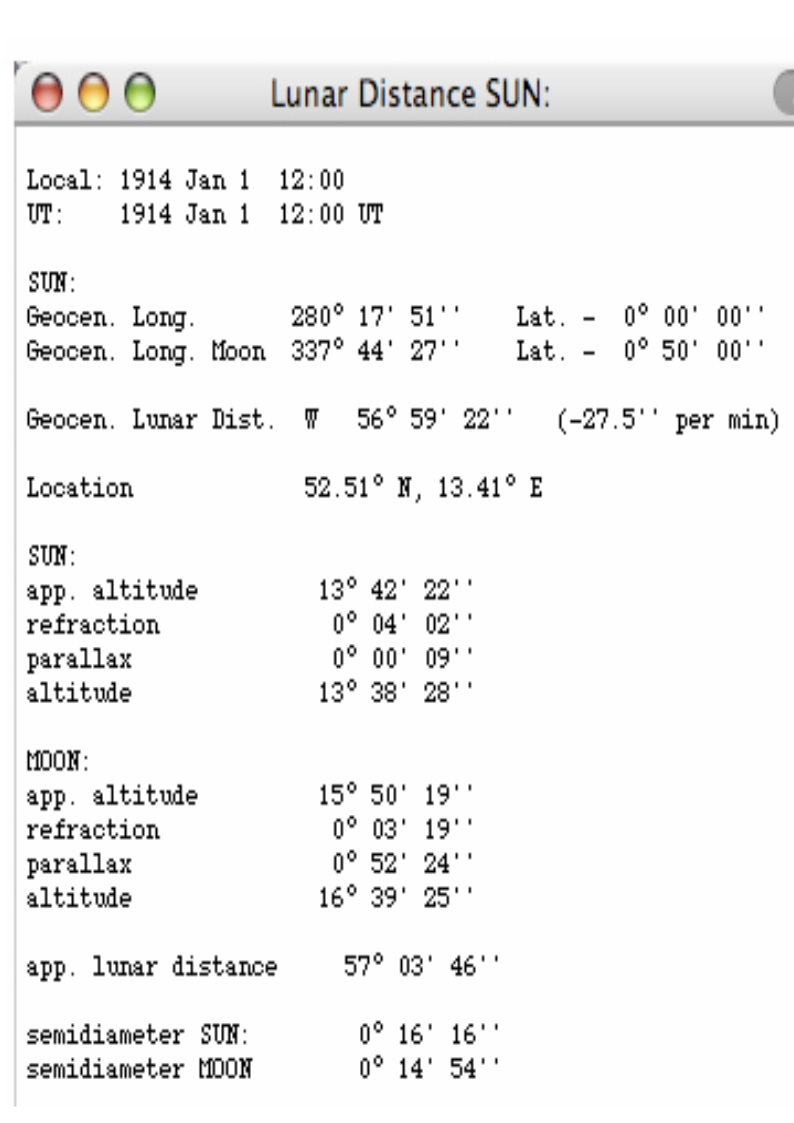
The navigator uses a sextant to measure the angle between the Moon and the Sun (or another celestial body); this is the lunar distance at his position.

The Nautical Almanac contains a table of lunar distances and the Greenwich Mean Time at which they occur on the Greenwich Meridian (see the extract below).

almanac

If the navigator measures the lunar distance at his position, he will be able to compare the result with the lunar distance at Greenwich as tabulated in the Nautical Almanac.  He will then be able to calculate the difference between the two measurements. In this way, he will be able to calculate the Greenwich Mean Time and by comparing this with his local time, he will be able to calculate his longitude.

For example if the difference in Lunar Distance is 2.5o  then the time difference must be 2.5/0.5 = 5 hours.  In 5 hours the Sun moves 5 x 15 = 75o  so the difference in longitude is 75o

Note.  Local time can be calculated by one of several methods, one of which is to measure the altitude of the Sun to determine when it has reached it’s zenith as this will indicate the occurrence of apparent noon.  Since this can be checked daily, a less accurate time piece than a chronometer could be used to record local time for a 24 hour period.  (In the 18th. and 19th. centuries, this could have been an hour glass).

Links:   Find Longitude,    calculate latitude,    sun as time keeper,   difference in time between meridians of longitude,      measuring altitude part 1,     measuring altitude part 2      measuring altitude part 3.

A fuller explanation of this topic is given in the book ‘Astro Navigation Demystified’.

Home page:  www.astronavigationdemystified.com

Posted in Uncategorized | Tagged , , , , , | Leave a comment

The Intercept Method

Astro Navigation DemystifiedAlthough it is usual these days to calculate an observed position in astro navigation by using the Rapid Reduction Method, there are other methods which do not necessitate the purchase of expensive reduction tables.  One of these methods is the Intercept Method.

The Intercept method , also known as the Marcq St. Hilaire method after the French Navigator who devised it in 1875, is a method of establishing a fix by measuring the altitude of a celestial body from the true position and comparing this with the calculated altitude at the DR position or the EP.  The difference between the two altitudes will be equal to the distance between the two positions and this distance is known as the intercept.

Suppose we are in a yacht and we measure the altitude of the Sun and find it to be 35o; what does this tell us?  All that we know is that the yacht lies somewhere on the circumference of a circle centred at the geographical position of the Sun.  Such a circle is known as a ‘position circle’ and when it is based on a sighting of a celestial body, as in this case, it is known as an Astronomical Position Line.  The diagram below shows that, at any point on the circumference of the circle, the Sun’s altitude will be 35and our distance from the GP will be equal to the radius.  The problem is to establish at which precise point on the position circle the yacht lies.

diag34 mod

At first, it might seem that all we need to do is to observe the bearing of the Sun at the same time that we measure its altitude and then draw the line of bearing on the chart along with the position circle.  In this way, it would seem that our true position would correspond to the intersection of these lines on the chart.  However, there is a problem with this idea which makes it impracticable.  Because of the great distance of the Sun from the Earth, the radius of the position circle will be very large (approximately 3000 nautical miles or so).  A chart on which such a large circle could be drawn would require such a small scale that accurate position-fixing would be impossible.

However there is another way of solving the problem.  We cannot physically measure the distance from the yacht to the GP but we can measure the altitude of the Sun at the true position and from that we can calculate the zenith distance as can be explained with the aid of the diagram below.

modified diag38

The true position of the yacht is represented by A in the diagram

Z represents the zenith of the true position

X represents the position of the Sun

U represents the geographical position of the Sun

ZX is the zenith distance and AU is equal to the angular distance ZX in nautical miles.

We can see that the zenith distance is equal to  90– Altitude.  So, measuring the altitude gives us a method of calculating the zenith distance and the zenith distance gives us the distance AU in nautical miles.

Now, If we calculate what the altitude would have been at the  Assumed Position (the D.R. or E.P. position) position at the time that the altitude was measured at the true position, we would then be able to compare the two altitudes and calculate the difference between them.

We can calculate the altitude at the assumed position by using either spherical trigonometry or by sight reduction techniques.  For the following example, suffice it to say that we have measured the altitude at the True Position and calculated the altitude at the Assumed Position.

Calculating the Zenith Distance at the True Position.  Suppose the Sun’s altitude, as measured at the true position, was 68o.06.  Using this information, the calculation for finding the zenith distance at the true position would be as shown below:

Zenith Distance = 90o– Alt

                                   = 90– 68o.06

                                    = 21.94 = 1316’.84

                                     = 1316.4 n.m.

Calculating the Zenith Distance at the Assumed Position.   Suppose that, at the same time as measuring the altitude at the true position, we find from the Sight Reduction Tables that the tabulated altitude at the Assumed Position is 67o.92; then the zenith distance would be:

Zenith Distance = 90o – Alt

                                  = 90o – 67o.92

                                  = 22o.08 = 1324’.8

                                  = 1324.8 n.m.

Therefore distance of the true position from the apparent position

= 1324.8 – 1316.4  =  8.4 nautical miles.

Alternatively, we could simply find the difference between the two altitudes and convert this to nautical miles as follows:

Alt. at true position           = 68o.06

Alt. at assumed position = 67.92

Z.D.  = 68o.06 – 67o.92      =   0o. 14   =   8.4 nautical miles

However, we must remember that this only gives us the distance and not the direction of the true position from the assumed position.  To find the direction, we can either measure the true bearing of the Sun from the true position or we can calculate the azimuth from the assumed position.

We know that the azimuth and the compass bearing provide exactly the same directional information albeit in different formats.  This begs the question: Why go to the trouble of calculating azimuth when it is easier to take the compass bearing?  However, there are essential differences between the calculated azimuth and the bearing measured by a compass.  We calculate the azimuth from data relating to the assumed position.  If we take a compass bearing, obviously we can only do that from the true position.  At the time of taking the altitude, we would not know where the true position is although we would know how far it is from the assumed position. There is also the point that the azimuth calculations relate to GMT and so the azimuth will relate to the mean sun whereas a compass bearing would obviously relate to the apparent sun.  Therefore, our aim must be to find the direction of the true position from the assumed position and we can only do this by calculating the azimuth.

Suppose that, for simplicity’s sake, the azimuth for the assumed position taken from the tables and converted to a bearing is 180o.  This simply tells us that the direction of the GP from the assumed position is along the bearing 180o.   However, we need to know if the true position is 8.4 miles from the assumed position towards the GP or away from it.  We know that if we move towards the Sun, its altitude will increase and if we move away, it will decrease.  So, since the altitude at the true position is greater than at the assumed position we can say that the true position is 8.4 miles from the assumed position towards 180o and this is known as the intercept.

To summarise, we have calculated that the intercept is 8.4 nautical miles from the assumed position towards 180o  but does this tell us exactly where the true position is?  Unfortunately not; we must remember that the assumed position is approximate and therefore the position that we have found 8.4 miles from it must also be an approximate position.  The next diagram shows how this might be drawn on a chart.

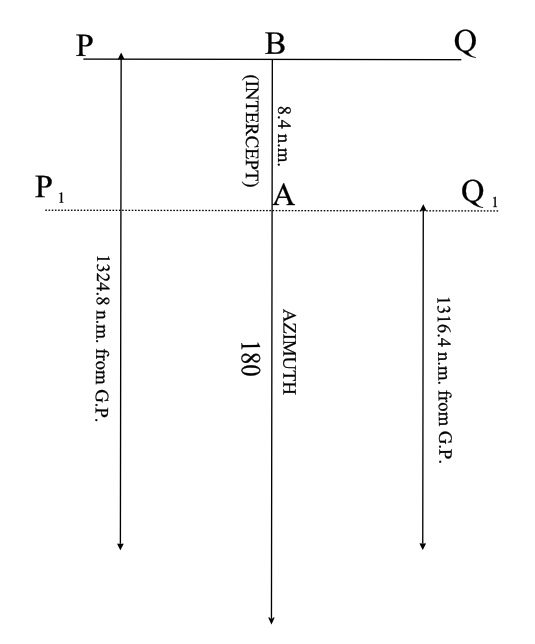
diag42mod new 2

The line PBQ represents part of the circumference of a position circle of radius 1324.8 nautical miles centred at the GP on which the assumed position (B) lies.

The line P1AQ1 represents part of the circumference of a position circle of radius 1316.4 nautical miles centred at the GP on which the true position (A) lies.  The line BA represents the intercept which we have calculated to be 8.4 nautical miles in the direction 180o from the assumed position.

Note.  Since the circumference of a circle at any point is at right-angles to the radius at that point, no accuracy will be lost by drawing the small arcs PBQ and P1AQ1 as a straight lines at right-angles to the intercept

However, we still have only one position line whereas we need at least two position lines to make a fix on the chart.  So how can we use the intercept method to establish a fix?

The answer is quite simple.  We can lay off on the chart, the vessel’s course and distance run over the next hour (say 315, 15 nautical miles) to establish a new assumed position and from the new assumed position we can calculate a new position line.  At the same time, we can transfer the first position line over the course and distance travelled by the vessel in that hour.  The True Position will be at the point of intersection of the new position line and the transferred position line as shown in the diagram below.

diag44MOD new

 A fuller explanation of this topic is given in the book ‘Astro Navigation Demystified’.

Astro Navigation blog:  Astro Navigation Demystified.

web: www.astronavigationdemystified.com

Posted in astro navigation, astronomy, celestial navigation | Tagged , , , | Leave a comment

Rhumb Line Sailing

Terminology.  The following terms are used in this exercise:  Rhumb Line, Departure, D.Long, D.Lat, Mean Lat,      Mid. Lat.To find the meaning of these terms, click here  

Short distance sailing is a term which is applied to sailing along a rhumb-line for distances less than 600 nautical miles.  The following formulae are used extensively in short distance sailing:

To Calculate Departure when the course is not known:  dep.= d.long cos(mean lat)

To Calculate Departure when the course is Known:  Dep  = Dist x Sin(course)

To Calculate Distance when departure and course are known:

Dist  =   Dep  / Sin (course)

To Calculate Dlat when the distance and course are known: DLat = Dist x Cos(course)

To Calculate Course to Steer (the rhumb line course between two points):

Tan(course) =   Dep / D.Lat

To calculate Dlong (difference in longitude corresponding to the departure):

DLong.  =  Dep. x Sec(Mean.Lat)   or   Dlong =      Dep  / Cos(Mean.Lat)

 Example.  What is the rhumb line course to steer and the distance to travel from position 40o.5N, 43o.0W to position 42o.25N 41o.8W? 

Solution:

Dlat      = 42o.25N – 40o.5N  = 1o.75N = 105’

Mean Lat = 40o 30’N + (105′ / 2) = 40o 30’N +  52’.5  = 41o 22’.5N = 41o.38

Dlong        = 43o.0W – 41o.8W  = 1o.2E = 72’E

Dep           = d.long x cos(mean lat)  = 72 cos(41o.38)  = 54’.02

Tan(course)  = Dep / D.Lat   =    54.02 / 105  = 0.51

Therefore course =  0.51-1 = 27o

Therefore, Course to steer = 027o 

Dist         =     Dep / Sin (course)  =  54.02 / Sin(27)  = 120’

Therefore, Distance to new position = 120 n.m.

Exercise Questions

 Question 1.  At 1230 GMT, a ship receives an S.O.S. signal from a vessel in position 23o.25S, 120o.5W.  Her own D.R. position is 20o.4S, 118o.3W. What is the rhumb line course to steer to reach the S.O.S. position and what will be the E.T.A. if the speed is 25 knots?

Question 2.  If a ship starts from position 30o 21’N, 1554’W and travels on a course of 030o at 12 knots for 5 hours, what will be its new position?

 Question 3. At 0930, a ship’s position is 48o 18’.75S, 29o  28’.30E.  Course is 148o  and speed is 28 knots.  What will be the ship’s position at 1158?

Question 4.  A yacht’s D.R. position at 0800 is 36o 23’.4N.  09o 15’.4W.  The Skipper estimates that the course and speed made good for the next 4 hours was 075o, 6 knots.  What was the estimated position at 1200?

  ‘Click here for exercise answers’

A fuller explanation of this topic is given in the book ‘Astro Navigation Demystified’.

Home page:  www.astronavigationdemystified.com

Posted in Uncategorized | 1 Comment

How To Find Longitude

The longitude problem.  The measurement of longitude was a problem  until well into the 18th. century.  Determining latitude was relatively easy because it could be calculated from the altitude of the sun at noon but for longitude, early navigators had to rely on dead reckoning. This was inaccurate on long voyages out of sight of land and a solution to the problem of accurately calculating longitude eluded navigators for many centuries until John Harrison invented the chronometer in the 18th. century.

In July 1714 the British Parliament  passed the Longitude Act and this established a Board of Longitude which offered a £20,000  prize for the person who could invent a means of calculating longitude. Harrison was tempted by the prize and set out to produce an accurate timepiece which could be used to compare local time to Greenwich time (which the timepiece would be set to).  He completed his chronometer in 1759 after several previous attempts and this proved to be so successful that it was used by Captain Cook in his voyages after 1772.

Explanation of the method calculating longitude using a chronometer.

Angular distance between meridians of longitude.  The Earth’s equatorial circumference is 21640.6 n.m.  Since the Equator is a great circle, 1o will subtend an arc of: 21640.6  =  60.113  ≈  60 n.m.   There are 360 meridians of Longitude so it follows that, measuring from the Earth’s centre, the angular distance between adjacent meridians at the Equator is 1o.  Since 1o subtends an arc of 60 n.m. it follows that the distance between adjacent meridians of longitude at the Equator is 60 n.m.   So the angular difference between longitude 10o West and the Greenwich Meridian is 10o; therefore, the distance between them at the Equator is 10 x 60 = 600 n.m.

Time difference between meridians of longitude. We know that the Earth revolves about its axis once every 24 hours.  In other words, the Sun completes its apparent revolution of 360o in 24 hours.  This  means that the Sun crosses each of the 360 meridians of longitude once every 24 hours. So, in 1 hour, the Sun appears to move 15o, in 4 minutes, it appears to move 1o, in 1 minute it appears to move 15′, in 4 seconds it appears to move 1′.

From this, it becomes obvious that there is a direct relationship between arc and time such that 1 minute of time equals 15 minutes of arc.

Calculating longitude by comparing time difference.  If we have two accurate clocks, one calibrated to GMT and the other calibrated to local time, then it is an easy matter to calculate our longitude from the difference between the two times.

For example, if the difference between GMT and local time is three hours, then the difference in longitude must be 3 x 15o.  If local time is ahead of GMT then the local longitude must be East of the Greenwich Meridian and if local time is behind GMT the longitude must be West.

Example:  If it is 18.00 GMT when it is 09.20 local time on the same day, then  local time must be  8 hours and 40 minutes behind GMT.  Therefore Long  = – [(8 x 15o) + (40 ÷ 60 x 15o )]     = – [120o + 10o]     =   -130o   = 130o West

A fuller explanation of this topic is given in the book ‘Astro Navigation Demystified’.

Links:  Calculating Latitude.     Astro Navigation Demystified

Home page:  www.astronavigationdemystified.com

Posted in Uncategorized | Tagged , , , , | Leave a comment

What are Local Hour Angle and Greenwich Hour Angle

Local Hour Angle (LHA). In astro navigation, we need to know the position of a celestial body relative to our own position.

In the diagram below:

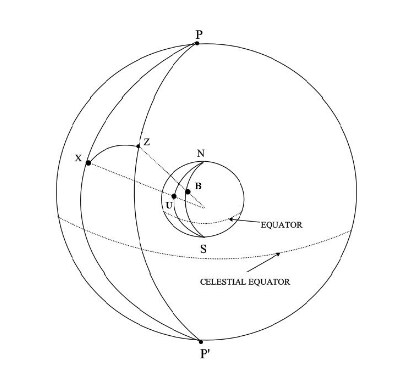
diag 3 no number

LHA is the angle BNU on the Earth’s surface which corresponds to the angle ZPX in the Celestial sphere. In other words, it is the angle between the meridian of the observer and the meridian of the geographical position of the celestial body (GP).

Due to the Earth’s rotation, the Sun moves through 15o of longitude in 1 hour and it moves through 15 minutes of arc in 1 minute of time. So the angle ZPX can be measured in terms of time and for this reason, it is know as the Local Hour Angle.

LHA is measured westwards from the observer’s meridian and can be expressed in terms of either angular distance or time. For example, at noon (GMT) the Sun’s GP will be on the Greenwich Meridian (0o). If the time at an observer’s position is 2 hours and 3 minutes after noon, then the angular distance between the observer’s meridian of longitude and the Greenwich Meridian must be (2 x15o ) + (3x 15’) = 30o 45’. Because it is after noon at the observer’s position, the longitude of that position must be to the East of the Greenwich Meridian since the Earth rotates from West to East. Therefore the observer’s longitude must be 30o 45’ East and since LHA is measured westwards from the observer’s meridian, the LHA must also be 30o 45’. However, it should be noted that as the Earth continues to rotate eastwards, the GP of the Sun will continue to move westwards so the LHA at the observer’s position will be continually changing.

Greenwich Hour Angle (GHA). As discussed above, the angle between two meridians of Longitude can be expressed as an hour angle. The hour angle between the Greenwich Meridian and the meridian of a celestial body is known as the Greenwich Hour Angle.

The Local Hour Angle between an observer’s position and the geographical position of a celestial body can be found by combining the observer’s longitude with the GHA as shown in the following diagram.

diag 5 nonum

O represents the longitude of an observer; G represents the Greenwich meridian; X represents the celestial meridian of a celestial body such as the Sun.

In this case it can be seen that LHA is equal to the observer’s longitude plus the GHA of the celestial body.  However, the method of calculating LHA depends on whether the observer’s longitude is east or west of the Greenwich meridian.  A fuller explanation of this topic is given in the book ‘Astro Navigation Demystified’ but the rules below will help you to make the calculations without necessarily having a full understanding.

Rules for calculating LHA:

Long East, LHA = GHA + LONG (- 360o as necessary)

   Long West, LHA = GHA – LONG (+ 360o as necessary)

 Example 1. : If Long. is 90oE. and GHA is 300o

Then LHA = GHA + LONG -360o

= 300o + 90o = 390o – 360o = 30o

 Example 2: if Long. is 90oW. and GHA is 45,o we have:

LHA = 45o – 90o = -45o + 360o = 315o

 Example 3:  If your longitude is 35o 46’ East and the GHA of Mars is 39o  53’.8.  What is the LHA?

Remember the rule:  Long East, LHA = GHA + LONG (-360o )

GHA   =  39o  53’.8

LONG =  35o  46’.0E    (+)

LHA    =  75 o 39’.8   .

(Remember 60 minutes in 1 degree)

Example 4.  Your assumed longitude = 125o 13’.0W.  The GHA of the Sun is 243o 44’.7  What is the LHA?

Long West, LHA = GHA – LONG (+360o ?)

GHA    =    243o 44’.7

LONG  =    125o 13’.0W   (-)

LHA     =    118o  31’.7

 Example 5.  

Longitude is 120oW. GHA is 70o.

What is the LHA?

LHA = GHA – LONG (+360o ?)

GHA   =    70o  00’.0

LONG =  120o  00’.0 W.  (-)

LHA   =  -50o 00’.0

360o  00’.0      (+)

LHA   =  310o  00’.0

Example 6.  Longitude is 90oE. GHA is 340o

What is the LHA?

LHA = GHA + LONG (-360o ?)

GHA   =  340o

LONG =   90oE     (+)

LHA   = 430o

360o            (-)

LHA   =  70o

 A fuller explanation of this topic is given in the book ‘Astro Navigation Demystified’.

Link:  Astro Navigation Demystified.

web: www.astronavigationdemystified.com

Posted in Uncategorized | Tagged , , , | Leave a comment

What are Azimuth and Altitude

Azimuth and Altitude part 1

We can define the position of a celestial body in relation to its local hour angle and declination.  We can also state its position in relation to our own celestial meridian and celestial horizon; in other words, in terms of its azimuth and altitude from our position.

The Azimuth is similar to the bearing in that it is the angle between the observer’s meridian and the direction of the celestial body.  However, whereas bearings are measured clockwise from north from 000 to 360 degrees. azimuth is measured from 000 to 180 dergrees from either north or south.  If the observer is in the northern hemisphere, the azimuth is measured from north and if in the southern hemisphere, it is measured from south.

For example, in the following diagram,

diag 21 (1)

O is the position of an observer on the Earth’s surface and NOS represents the observer’s meridian.

X is the position of a celestial body and in terms of bearing, the direction of X from point O is 045 degrees.

In terms of azimuth it is either N45E for an observer is in the northern hemisphere or S135E for an observer in the southern hemisphere.

The altitude is the angle between the celestial horizon and the direction of the celestial body.  (The celestial horizon is the projection of the observer’s horizon onto the celestial sphere).

As shown in the next diagram, the observer measures the altitude in relation to the visible horizon from his position at O on the Earth’s surface.  So, the observed altitude is the angle HOX.  However, the true altitude is measured from the Earth’s centre in relation to the celestial horizon and is the angle RCX.

diag22nonum

Point O will be approximately 6367 Km. from the centre of the Earth and so it would seem that the visible horizon is bound to be slightly offset from the celestial horizon.  Because of the vast distances of the stars and the planets from the Earth, we can assume that, in their cases, the celestial horizon and the visible horizon correspond with very little error.  However, in the cases of the Sun and the Moon, which are relatively near, a correction called Parallax must be added.  The subject of Parallax error and other corrections will be dealt with in in another post.

The next post in this series will explain the place of azimuth and altitude in the theory of astro navigation.

Links:     Azimuth and Altitude Part 2   Azimuth and Altitude Part 3 

It is possible only to give a brief outline of this topic here but an in-depth treatment is given in my book Astro Navigation Demystified.

web:  www.astronavigationdemystified.com

Posted in Uncategorized | Tagged , , , | Leave a comment