Calculating the Sun’s Declination in a Survival Situation

In an ideal situation, we could find our latitude by using a satellite navigation system.  If sat-nav is not available, we can use astro navigation to calculate our latitude by the method shown at the following links:

Latitude from the Midday Sun   Finding Latitude in a Survival Situation.

For this method, we need to know the Sun’s declination which we can take from a nautical almanac, a web site or phone app.  However, in a survival scenario, especially in an ‘escape and evasion’ situation,  it is extremely unlikely that we will have access to sat navs, computers, smart phones or nautical almanacs.

So, what is needed, is a method of calculating the Sun’s declination without reliance on any aids whatsoever and the method described below fits that criterion exactly.

The method which is fully explained in the book ‘Understanding Astro Navigation’, evolved from the discovery that, if the daily values of the sun’s declination are plotted on a chart, as shown below, the resultant curve will closely follow a sine wave with an amplitude of 23.5 and a period of 365.  The amplitude ± 23.5 of course, corresponds to the northerly and southerly limits of the Sun’s declination and the period of 365 corresponds to the number of days in the year (discounting leap years).

The day numbers, along the x-axis, commence with 1 on 21st March (the vernal equinox) and continue to 365 when the next vernal equinox is reached.  Because the daily declination values are averaged over the leap year cycle, the 366th day of the leap year is ignored and so for the 29th February, either day 365 or day 1 is used.  (There will be a negligible difference between the values shown for these days).

Method 1.  This method requires the use of a scientific calculator or set of trig tables and is not really suitable for a typical survival situation when these items are not likely to be available.  However, it is useful to work through this method in order to better understand the non-calculator method.

The discovery that a graph of the values of declination follow a sine wave led to the derivation of the following formulas for calculating the declination on any day of the year.  Because of small variations in the patterns for the two halves of the year, separate formulas were necessary.

For the period 21 March (vernal equinox) to 22 September (autumnal equinox):  Declination = 23.5 Sin(0.973n) where n is the day number.

For the period 23 September (autumnal equinox) to 21 March (vernal equinox):  Declination = 23.5 Sin(n-5)

To summarize:

Dec = 23.5 Sin(0.973n)    :  n < 181

Dec = 23.5 Sin(n – 5)       :  n > 180    (where n is the day number)

Method of use.  The following examples demonstrate the use of these formulas.

Example 1.  Calculate the Sun’s declination on 27th May.                      

  1. Using a calendar, count the days from 21st March to 27th May.  (If you don’t have a calendar, use the  mnemonic rhyme ‘30 days has September’ which is repeated below).
  2. If the date is 27th May, the day number is 67.
  3. Use the formula for the period 21 March to 22 September to calculate the declination as follows:

Dec = 23.5 Sin(0.973n)  (where n is the day number)

= 23.5 Sin(0.973 x 67)

=  23.5 x Sin(65.191)

=  21.3

Therefore, Dec =  21.3o North   (positive values indicate north).

If we check this result against the Sun’s Declination Table, we will find that the correct declination for 27 May is 21.2o North giving an accuracy of ±0.1o for our result which is within tolerance.

Example 2.  Calculate the Sun’s declination on 18th November.

  1. Count the days from 21st March to 18th November to find the day number.
  2. The day number for 18th November is 242.
  3. Use the formula for 23rd September to 21st March to calculate the declination as follows:

Dec = 23.5 Sin(n-5)    (where n is the day number)

= 23.5 Sin(242-5)

= 23.5 x Sin(237)

= -19.7

Therefore Declination = 19.7o South  (negative values indicate south)

If we check this result against the Sun’s Declination Table we will find that the correct declination for 18th November is 19.1o North giving an accuracy of ±0.6o for our result.

Method 2. Calculating the declination without using calculators, sine tables and calendars.  To make use of the formulas above we obviously need to use trigonometry tables or a scientific calculator as well as a calendar to work out the day number.  However, it more than likely that we will not have access to any of these in a true survival scenario.

All is not lost though because by using the knowledge gained above, we can make do without these things.

1.   Simple things first, if you don’t have a calendar you can use the  mnemonic rhyme ‘30 days has September’ which is repeated below).

’30 days has September, April, June and November; all the rest have 31 except for February alone which has 28 days but 29 in a leap year’.

Using this rhyme, you can easily make your own rough calculator to work out the day number.

Having worked out the day number, the next task is make a simple graph of the declination curve for the current period of the year.  This is much simpler than it might at first seem.

Consider the graph of the sine curve for the period 21st March to 22nd September shown below.  You will see that the day numbers are marked along the x-axis from 1 to 185 (185 being the day number for 22nd September). From the graph, you will see that the curve of the declination values creates a parabola with the vertex at 23.5 (the maximum value of the Sun’s declination).

So to re-create a copy of the graph proceed as follows:

  • Draw a horizontal number line with graduations from 1 to 185.  This will be the x-axis of the graph.
  • Mark off equal graduations from 0 to +23.5 up the y-axis.
  • Mark a point at the co-ordinate of x = 92 and y = 23.5; this will be the position of the vertex of the parabola.  (Day 92 is 21st June, the Summer Solstice or Midsummer).
  • Carefully draw a smooth curve from 0 on the x-axis through the vertex at y = 23.5 and back down to 185 on the x-axis to form a parabola as shown on the graph below.
  • The copy of the graph is now complete.

To find the declination on a certain day.

Example 1.  Using the data from example 1 above, find the declination on 27th May (day no. 67).

  • As shown on the chart above, draw a vertical line from 67 on the x-axis until it meets the curve.
  • From the point where the vertical line meets the curve, draw a horizontal line across to the y-axis and read off the declination.
  • From the chart, you will see that the resultant declination is 21o north (± 0.5o).
  • From the Sun’s declination table, we know that the declination on 27th May is 21.2and this shows that our result is reasonably accurate.

Example 2.  Using the data from example 2 above, find the declination on 18th November (day no. 242).

  • Using the method explained above, create a graph of the declination curve for the period 23rd September to 21st March  as shown in the chart below.
  • Use day numbers 186 to 365 for the x-axis.
  • Mark a point at the coordinate of x = 276, y = -23.5 to find the position of the vertex of the parabola.  (day no. 276 is 22nd December, the Winter Solstice).
  • Carefully draw the curve from x = 0 on the x-axis through the vertex and back to x-axis at x = 365 as shown below.
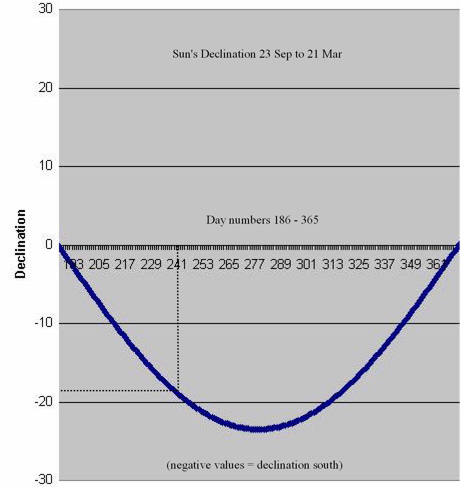
To find the declination on 18th November

  • Draw a vertical line from day no. 242 on the x-axis down until it meets the curve.
  • From that point, draw a horizontal line across to the y-axis and read off the declination.
  • From the chart below, you will see that the resultant declination is -19 i.e. 19south (± 0.5o).
  • From the Sun’s declination table, we know that the declination on 18th November is 19.1south and this shows that our result is well within tolerance.

Click here for more information about using astro navigation in a survival situation 

‘Astro Navigation Demystified’ is available from Amazon and from Nielsen Books.

‘Understanding Astro Navigation’ is available from Amazon.co.uk only.  Purchasers from outside the U.K. should email bookcaselearning@btinternet.com

web: http://www.astronavigationdemystified.com

Posted in astro navigation, Survival | Tagged , , , , , , , , , , , , , | Leave a comment

Titanic and the Traverse Tables

Recent discussions regarding the possibility that the SOS position sent by the Titanic was incorrect due to mistakes made in applying the traverse tables make interesting reading.

Traverse tables have been used for about 200 years to solve the mathematical problems involved in short distance sailing.  The tables simply tabulate the results of relevant trigonometric calculations and would have been extremely useful to navigators in the days before electronic calculators became available.  However, it should be noted that, although traverse tables are reasonably accurate for short distance sailing, they are not accurate over long distances (over 600 nautical miles).  This is because data in the traverse tables is calculated using ‘straight line’ trigonometry which cannot be applied to long distance, great circle sailing involving the use of ‘spherical trigonometry’.

An exposition of the use of the traverse tables is given in my book ‘Astro Navigation Demystified’.

Posted in astro navigation, navigation | Tagged , , , , | Leave a comment

Planning Star and Planet Observations

I have been asked about using ABC tables to calculate azimuth and altitude when planning star and planet observations.  Unlike the Sun and the Moon which are easily identified, the approximate positions of stars and planets need to be established before observations are made. The times of rising and setting of the Sun and Moon can be found in the daily pages of the nautical almanac so we know when they will be visible above the horizon.  Risings and settings for stars and planets are not listed and so their approximate positions need to be calculated.  There are various techniques and devices that can be used for this purpose such as ‘star globes’,  ‘star charts’, computer software and of course the ABC tables.  The ABC tables can be found in books of nautical tables such as Norie’s and Burton’s and can be used to calculate the approximate azimuth and altitude of celestial bodies.

My book ‘Astro Navigation Demystified’ teaches the use of the ‘Rapid Sight Reduction Tables For Navigation’.  The procedures for using these tables includes a ‘Planning Phase’ and a ‘Fix Phase’.  In the planning phase, the approximate azimuth and altitude of chosen celestial bodies are calculated before the process of taking the sights is undertaken in the fix phase.  So, by using these tables, the need to clutter the chart table with star globes, hefty volumes of nautical tables and other paraphernalia is avoided which can be a blessing in a yacht or other small craft.

Furthermore, the mathematical solution of the triangle PZX by the use of spherical trigonometry is time consuming and gives considerable scope for arithmetical error.  Time and accuracy are of the essence in practical navigation and the Rapid Sight Reduction Tables enable us to obtain the solutions of the triangle PZX for all combinations of Declination, Hour Angle and Latitude so that we can calculate altitude and azimuth by relatively simple table operations without the mental torture of making calculations by spherical trigonometry.

Of course, when selecting the celestial bodies for our observations, it is necessary to make sure that they will be visible above the horizon before we go to the trouble of calculating their expected approximate azimuth and altitude.   In ‘Astro Navigation Demystified’ you will find a ‘rule of thumb’ method for doing this without any complicated calculations or the use of complicated nautical tables.

www.astronavigationdemystified.com

Posted in astro navigation | Tagged , , , , , , , , , , , , | Leave a comment

Astro Navigation In A Survival Situation

In a recent survey, the majority of people questioned were surprised to learn that astro navigation can be used in a survival situation.  In the same survey, 60% said that they would use satellite navigation systems to find their way if they were lost and that they wouldn’t know what to do if they did not have access to such equipment.

There are two types of survival situation in which astro navigation can be used to help people to establish their position and these are ‘Survival at Sea’ and what we term as ‘Wilderness Survival’.

Survival at sea.  The simple astro navigation techniques listed below could be used by survivors in the following circumstances:

  • In mid ocean, adrift in a lifeboat without GPS.
  • In mid ocean, suffering electrical failure resulting in loss of radio, radar, and global posistioning system (GPS) but unable to use full astro navigation techniques .
  • In mid ocean, unable to use full astro navigation techniques but experiencing long term failure of GPS system .

Wilderness survival  The simple astro navigation techniques listed below could be used by the following types of survivor assuming that they are lost in a wilderness and have no access to GPS or a mobile phone.

  • Back-packer.
  • Aircraft crash survivor.
  • Shipwreck survivor.
  • Military personnel in ‘escape and evasion’ situation in a war zone.
  • Escapee from prisoner of war camp in a war zone.
  • Refugee from a war zone.

Frequently asked questions

  • How likely is it that GPS could fail?  Click here for a full answer to this question.
  • How many war zones are there?  There have been over 150 major and minor wars since 1945.  There are currently 10 major wars taking place and 32 civil wars.
  • What is a wilderness?  There are many definitions of  a wilderness but the one commonly accepted is: ‘A wild place that is sparsley inhabited, is not developed with towns, roads, any form of industrial infrastructure and has no form of electronic communications system’.

Astro Navigation methods that could be used in survival situations.

There are three methods that could be used in a survival situation as follows:

  1. Finding your latitude from the Pole Star (Polaris).  Click here  to find out how.
  2. Finding your latitude from the midday Sun.  Click here to find out how.
  3. Finding your longitude from the midday sun.  Click here to find out how.

Fixing your geographical position in lat.and long.at midday.  By measuring the Sun’s altitude at midday, your geographical position in terms of latitude and longitude can be calculated by using methods 2 and 3 above.

Equipment needed for the above methods.  Only the following very basic equipment is needed to use these methods:

  • A home-made mini clinometer for measuring angles.  Click here to learn how to make one.
  • A piece of smoked glass to be used so that the altitude of the Sun can be measured without damaging a person’s eyesight.  (If a piece of manufactured smoked glass cannot be obtained, simply hold a piece of glass in the smoke of a candle or oil lamp until it is covered in a layer of smoke residue).
  • A watch, set to GMT (this is only required for method 3).
  • Declination table.  (this is only needed for method 2).  Go to declination table.  (Note.  A sea going vessel with a current nautical almanac would not need this declination table).
  • A magnetic compass (not essential for these methods).

Be prepared.  It is recommended that you prepare the above equipment and store it in your rucksack in case it is needed in a wilderness survival situation or store it in your boat ‘grab’ bag in case it is needed in a survival at sea situation.

www.astronavigationdemystified.com

Posted in Astro Navigation Topics, Survival | Tagged , , , , , , , , , , , , | 8 Comments

Finding Latititude In A Survival Situation.

The  full method of calculating your latitude from the altitude of the Sun can be found at this link.  However, in a survival situation, the following simplified method can be used.

Equipment Needed. 

  1. A clinometer or other device for measuring angles.
  2. A copy of the Sun’s Declination table.
  3. A magnetic compass.

(A  full list of equipment required for survival astro navigation can be found here)

How to tell when it is midday in your exact geographical position.

Firstly, it is important to remember that midday in your exact position will very rarely co-incide with noon in standard time or zone time because these time systems cover very large geographical areas.  True midday is when the Sun lies directly over your meridian of longitude and so, depending on your geographical position, the Sun will bear either due north or due south at midday.

Use the following method to determine when it is midday at your position.

  1. If you have a compass, use it to determine when the sun’s bearing is approaching due north or south.
  2. Using a clinometer and a smoked glass filter, begin to measure the sun’s altitude at frequent intervals just as it approaches north or south.
  3. Midday will occur when the sun reaches its highest altitude.
  4. Make a note of the highest altitude reached.

Calculating your latitude from the Sun’s altitude at midday.

The following method depends on you having a rough idea of your latitude to begin with.  For example, in the Sahara, you will be between 15o and 35North; in Nepal, you willl be between 26o and 28o North; and in the Amazon, you will be between 0o and 15o South.

Method of calculating latitude.

  1. Consult the declination table to find the declination for the day.
  2. Determine whether the declination is north or south.
  3. Determine whether your latitude and the declination have the same or contrary  names (north or south).
  4. Apply the rules below to calculate your latitude.

Rules.  The method depends on the following three simple rules:

(i)   Latitude and declination have same names and latitude greater than declination:

LAT  =  DEC + (90o – ALT)

(ii)   Latitude and declination have same names and declination greater than latitude:

LAT  =  DEC – (90o – ALT)

(iii)   Latitude and declination contrary names:

LAT  =  (90o – ALT) – DEC

Examples:

1.   Using rule (ii)

Scenario:  True altitude at midday: 69.7o

Sun’s declination: 20.8o North

Approx latitude:  0o – 5o North (in a coastal region of Borneo).

Sun’s expected bearing at midday: North.

LAT  =  DEC – (90o – ALT) (rule ii)

= 20.8o – (90o – 69.7o)

= 20.8o – 20.3o

= 0.5o North.

2.   Using rule (iii)

Scenario:  True altitude at midday: 80.9o

Sun’s declination: 2.7o  South

Approx latitude:  5o – 10o North (in Somalia)

Sun’s expected bearing at midday:  South (but more overhead).

LAT = (90o – ALT) – DEC (rule iii)

= (90– 80.9o) – 2.7o

      = 9.1– 2.7o  = 6.4North.

3.   Using rule (i)

Scenario:  True altitude at midday: 72.5o

Approx latitude: 35o – 45o South  (at sea in mid Pacific)

Sun’s declination: 23.2o South

Sun’s expected bearing at midday: North

LAT  =  DEC + (90o – ALT) (rule i)

= 23.2o  + (90o – 72.5o)

= 23.2o  + 17.5o

= 40.7o South.

=  40o  42’ South

 www.astronavigationdemystified.com


Posted in Astro Navigation Topics, navigation, Survival | Tagged , , , , , , , , , , , , | 7 Comments

Astro Navigation – What is it and why do we need it?

Astro-navigation (or celestial navigation as it is also known) is a fascinating subject that encompasses many areas of knowledge including geography, astronomy, history and mathematics.  As you unravel the principles and techniques upon which navigation is based, you will be left in awe of the sheer genius of the ancient scholars and mariners who developed the art over the centuries to a highly sophisticated form.

Yet, sadly, the art of astro-navigation lies dormant.  The ever-increasing demands for speed and simplification and the ever-decreasing time available for training in navigation, coupled with phenomenal advances in technology have resulted in navigators relying almost completely on automated navigation systems.

Russia is one of the few countries in the world to acknowledge the educational value of astro-navigation and to include it as an important part of the school curriculum.

 Why not just rely on the Global Positioning System (GPS)?

Quite apart from the local risks of defective equipment, battery failure, generator failure and short-circuits to electronic navigation equipment caused by flooding, there is a very real global danger that the GPS could be destroyed.  Couple the danger of solar storms with that posed by cyber terrorists who could block GPS signals at any time, then it can easily be seen that navigators who rely solely on electronic navigation systems could be faced with serious problems.  Click here to learn more about GPS failure.

So, how could seafarers navigate the oceans if the global positioning system (GPS) failed?  The answer is, they could revert to the tried and tested art of astro navigation.

What Is Astro Navigation?  Whereas, in coastal navigation, we can obtain ‘position lines’ by measuring the angular distances between lighthouses and other geographical features, in astro navigation we obtain position lines by measuring the angular distances between ‘celestial bodies’.

In the diagram below, X and Y represent two celestial bodies and X’ and Y’ represent their corresponding positions on the imaginary celestial sphere.  It can be seen that the angular distance between X and Y is exactly the same as that between X’ and Y’.  So, even though the celestial bodies are really at X and Y, no error is introduced by assuming that they are at X’ and Y’.

As discussed above, we can obtain position lines by measuring the angular distances between X’ and Y’.  However, because the observer, at point O, is on the surface of a sphere and X’ and Y’ are on the surface of an imaginary sphere, we cannot solve the angle X’OY’ by the use of ‘straight line trigonometry’; instead we must resort to the use of ‘spherical trigonometry’.

What Is Spherical Trigonometry?  Sounds difficult I know but if you want to see a brief explanation of the topic please click here.

www.astronavigationdemystified.com

Posted in Astro Navigation Topics, Schools | Tagged , , , , , , , , , , , , , | 1 Comment

Finding Longitude In A Survival Situation.

We know that the Earth revolves about its axis once every 24 hours.  In other words, the Sun completes its apparent revolution of 360o in 24 hours.  This means that the Sun crosses each of the 360 meridians of longitude once every 24 hours.

So, in 1 hour, the Sun appears to move 15o,

in 4 minutes, it appears to move 1o,

in 1 minute it appears to move 15′,

in 4 seconds it appears to move 1′.

From this, it becomes obvious that there is a direct relationship between arc and time such that 1 hour of time equals 15 degrees of arc.

For example, if the difference between Greenwich Mean Time (GMT) and Local Mean Time is three hours, then the difference in longitude must be 3 x 15o.  If local mean time is ahead of GMT then the  longitude must be east of the Greenwich Meridian and if local time is behind GMT the longitude must be west.

i.e.  GMT Least, Longitude East

        GMT Best. Longitude West

It is important not to confuse local mean time (LMT) with standard time or zone time.  LMT is the mean time along a single meridian of longitude whereas standard time is a time adopted for convenience sake within a country or region and may encompass a very wide area.  In the case of zone time, a zone covers a range of 15o of longitude and the time within that zone is the LMT of its center meridian of longitude.

In a survival situation, there is only one time of the day that you can be sure of the actual local time at your position and that is at midday.  This is because, at midday, the Sun momentarily lies over your meridian of longitude.  We know that at midday, the Sun is at its highest altitude and we can use this knowledge to calculate our longitude in the following way.  (This method assumes that you have the equipment listed in the post ‘Astro navigation in a survival situation’).  (This equipment includes a watch set to GMT).

Note.  Survivors on land could tell when it is noon by making a survival sundial.

We must be careful here to make the distinction between ‘mean time’ and ‘apparent time’.  The sun that we see in the sky is the ‘True Sun’ not the theoretical ‘Mean Sun’ which  simply provides us with a convenient regular time system that we use to overcome the variations in the movement of the true sun.  So when we see the sun reach its highest altitude, we know that it is ‘apparent noon’ but this may differ by a few minutes from ‘mean noon’.  However, in a survival situation, an error of a few minutes is acceptable, especially since the altitude of the sun changes very slowly as it approaches is zenith.  To summarize, in a survival situation, we can assume that ‘apparent noon’ and ‘mean noon’ coincide.

It is also worth distinguishing between Greenwich Mean Time and Universal Time in case there is any confusion about this.  The term Universal Time (UT) was adopted internationally in 1928 as a more precise term than Greenwich Mean Time because GMT can refer to either an astronomical or a civil day.  However, the term Greenwich Mean Time persists in common usage to this day and is generally considered to be synonymous with the term Universal Time.

Method:

  1. Use a clinometer to calculate when the Sun is at its highest altitude with the aid of a filter of smoked glass to protect the eyes.
  2. When the Sun reaches its highest altitude, note the time in GMT and make a note of the altitude reached.
  3. Calculate your longitude as shown in the following examples.

Example 1:  If it is midday local time and the time GMT is 07.45, then local time must be 4 hours and 15 minutes ahead of GMT.

Therefore, longitude = [4 x 15o] + [(15 ÷ 60) x 15o]

= 60o + 3.75o

= 63.75o

= 6345’ East (GMT least, longitude east).

Example 2:  If it is 17.50 GMT when  it is midday local time, then  local time must be  5 hours and 50 minutes behind GMT.

Therefore, longitude  = [5 x 15o] + [(50 ÷ 60) x 15o]

=  75o + 12.5o

=  87.5West   (GMT best, longitude west).

Fixing you Lat and Long.  If you note the highest altitude reached by the Sun at midday, as recommended in the method above, you can use this information to also calculate your latitude.  In this way you will be able to establish a Lat and Long fix of your position.

www.astronavigationdemystified.com

Posted in Astro Navigation Topics, Survival | Tagged , , , , , , , , , , , , | 4 Comments

Latitude from Polaris

Using The Pole Star (Polaris)  To Find Your Latitude

Assume that the Pole Star (Polaris)is exactly in line with the Earth’s axis produced, as shown in the following diagram.

To an observer O on the Equator (lat. 0o) the Pole Star will be in line with the horizon, i.e. it will have an angle of elevation or altitude of 0o.

Note.

1.       The Pole Star is slightly offset from the Earth’s axis but for the purposes of this exercise, we can assume that it is in line without any great loss of accuracy.

2.       Because of the great distance of the Pole Star from the Earth, we can also assume reasonably that the horizon corresponds to the Earth’s axis.

If the observer (O) were to move 60 n.m. due north from the Equator to a latitude of 1oN, then the altitude of the Pole Star will obviously increase to 1o (i.e. it will now be 1o above the horizon) as shown in the diagram below.

From this, we can see that, in the northern hemisphere, the altitude of the Pole Star corresponds to the latitude of the observer.  So, if a navigator measures the altitude of the Pole Star and finds it to be 45o, then he can conclude that he is at latitude 45oN.

How to locate the Pole Star (Polaris)

Want to know more?  www.astronavigationdemystified.com

Posted in Astro Navigation Topics, navigation, Schools, Survival | Tagged , , , , , , , , , , , , , | 4 Comments

Spherical Trigonometry Introduction


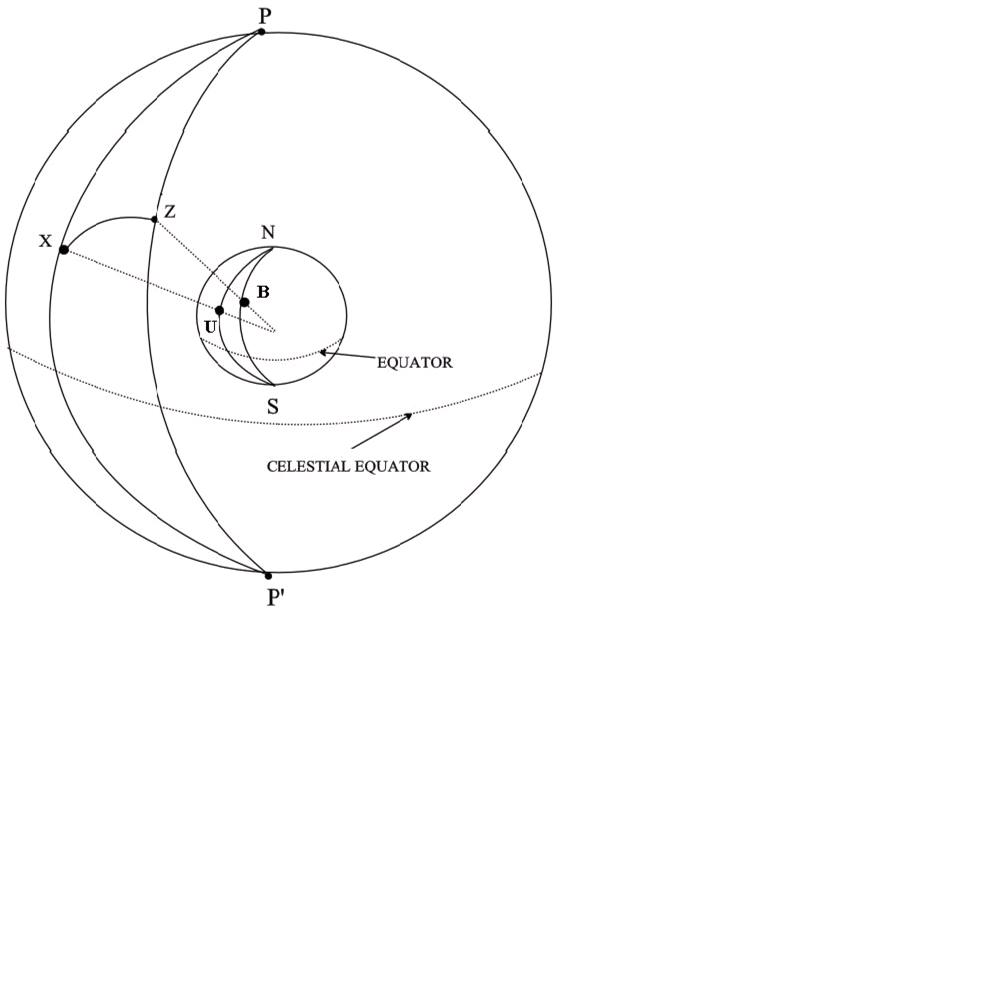
In the diagram above, the inner circle represents the Earth and the outer circle represents the celestial sphere.  Point N represents the North Pole, B represents an observer’s position on the surface of the Earth, and U represents the geographical position of a celestial body (the point on the Earth’s surface immediately below the body).  Points P, Z and X represent the projections of points N, B and U onto the imaginary celestial sphere.

In astro navigation, the aim is to find the position of point B in relation to point U and N.  The problem is that you would not be able to see the North Pole (point N) nor would you be able to see point U (the geographical position).  However, you would be able to see the celestial bodies in the sky.  So, although the spherical triangle NBU is inaccessible, you would be able to solve it, in effect, by solving the triangle PZX.  Unfortunately, things are not this simple because the celestial sphere and the surface of the Earth are curved and it follows that lines drawn on those surfaces must also be curved.  Therefore, to solve the triangle PZX we must employ ‘spherical trigonometry’.

The mathematical solution of triangle PZX by spherical trigonometry is lengthy, complicated and gives scope for arithmetical error.  Since time and accuracy are very important for the navigator, tables of computed altitude and azimuth (known as sight reduction tables) are available and these enable us to obtain solutions for all combinations of latitude, declination and hour angle.  However, to fully understand the complexities of navigating on the surface of a sphere, it would be helpful to have a knowledge of ‘spherical trigonometry’ and for this reason, an exposition of the topic is offered in below.

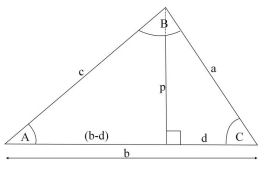
Consider the diagram below:

Cos A   =      d/c    and   d  =  c. Cos A

p2  =  c2 – d2   and  p2  =  a2 – (b-d)2

→   c2 – d2  =  a2 – (b-d)2

→   c– d2  =  a2 – b2 + 2bd – d2

→   c =  a2 – b2 + 2bd

→   c =  a2 – b2 + 2bc Cos. A (since d = c Cos. A)

→  a2  =  b2 + c2 – 2bc Cos. A

This is the cosine rule for ‘flat’ triangles but does this rule also apply to spherical triangles?

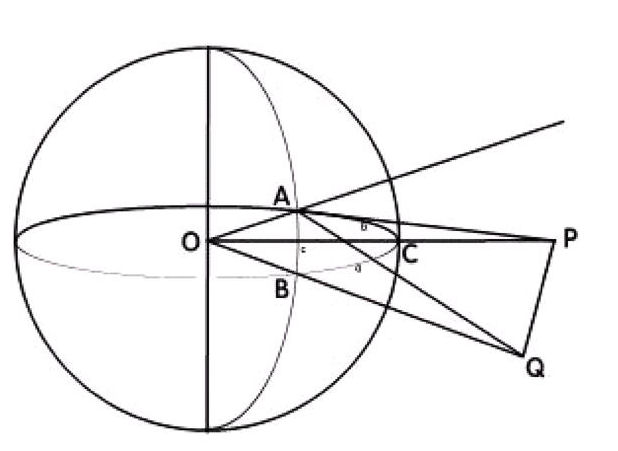
The next diagram shows a spherical triangle ABC formed by the intersection of three circles with their common centre O at the centre of the sphere.

The edges of the ‘flat’ planes in which the sides a, b, & c lie, meet along OA, OQ and OP.

The edges AQ and AP just graze the great circles of the arcs c and b at A;

that is, AQ is the tangent to c and AP is the tangent to b.  So angles OAQ and OAP are really right angles although it is impossible to draw them as such in the ‘flat’.

The edges of the three planes in which a, b, & c lie form a flat (two-dimensional) triangle PAQ, of which the apical angle PAQ is equivalent to the angle A of the spherical triangle.

Now, by the rule for ‘flat’ triangles, we have:

PQ2  =  PO2 + QO– 2PO . QO . Cos(a)

and     PQ2  =  PA2 +  QA– 2PA . QA . Cos(A)

→ [PO2 – PA2] + [QO2 – QA2] -[2PO.QO.Cos(a)]  + [2PA . QA .Cos(A)]  =  0

We also have:

PO2 –  PA2  =  AO2  and    QO2 – QA2  =  AO2

→     PO2 – PA2] + [QO2 – QA2]  = 2AO2

Substituting 2AO2 in the equation gives us:

2PO . QO . Cos(a)  =  2AO2 + 2PA . QA .Cos(A)

Dividing through by 2PO . QO, we have:

Cos(a) =  AO – AO + PA – QA  Cos(A)

PO    QO     PO     QO

=  [Cos(POA) . Cos(QOA)] + [Sin(POA) . Sin(QOA) . Cos(A)]

=  [Cos(b) . Cos(c)] + [Sin(b) . Sin(c) . Cos(A)]

Hence, the formula for finding the third side (a) of a spherical triangle when the other two sides (b and c) are known together with the included angle (A)

is:   Cos(a)  =  [Cos(b) . Cos(c)] +[Sin(b) . Sin(c) .Cos(A)]

(This is the cosine rule for spherical triangles).

In astro navigation, we apply this rule when solving the spherical triangle PZX.  For example, to find the side ZX in the spherical triangle PZX, we have:

Cos ZX  =  [Cos PZ. Cos PX] + [Sin PZ. Sin PX. Cos ZPX]

Practical Example:

Calculate Angle PZX

Cos PZX   =  Cos PX – (Cos ZX. Cos PZ) ÷ (Sin ZX. Sin PZ)

 =  Cos(66o.55)-[Cos(22o.028)xCos(44o.5)] ÷ [Sin(22o.028) x Sin(44o.5)]

= 0.3979 – [0.927 x 0.713] ÷ [0.375 x 0.7]

= 0.398 – 0.66095  ÷ 0.2625

= -0.2629 ÷ 0.2625

= -1

Therefore PZX    = 180o

Therefore Azimuth = N180oE  (since the latitude of the approximate position is north).

Web:  www.astronavigationdemystified.com

Posted in Astro Navigation Topics, Schools | Tagged , , , , , , | 1 Comment

Distance to the Horizon


The Pharos Lighthouse.  The Pharos Lighthouse or the Lighthouse of Alexandria as it was also known, was commissioned by Ptolemy Soter the ruler of Egypt and completed during the reign of his son Ptolemy II in about 270BC.  It was reputedly the first lighthouse in the world and stood on the small island of Pharos just off the coast of Alexandria.  The Lighthouse of Alexandria was later declared to be the eighth wonder of the ancient world and it lasted for one and a half thousand years until it was destroyed during the 14th. Century by a combination of earthquakes and warfare.

The Disappearing Lighthouse.  Seafarers leaving the port of Alexandria would have noticed that the Pharos Lighthouse would disappear over the horizon at a distance of approximately 21 nautical miles even though it stood approximately 120 metres above sea level.  This must have been a subject of great mystery at a time when it was believed that the Earth was flat.   Could it be that this mystery came to the attention of Eratosthenes around 240BC when he was the librarian of the Great Library of Alexandria and that it inspired him to prove that the Earth is a sphere.

 Calculating Distance to the Horizon    The story of the disappearing lighthouse leads us nicely to the navigational problem of calculating the distance at which an object of a known height should become visible on the horizon.  Pythagoras provides us with a method of solving this problem as shown below:

Consider the following diagram:

In the diagram,

A represents a ship’s position.

B is the top of the lighthouse.

B1 is the base of the lighthouse.

C is the Earth’s centre.

r is the radius of the Earth.

h is the height of the lighthouse.

By Pythagoras:

AB2  =  CB2 – AC2

→      AB2  =  (r + h)2 – r2

→      AB2  =  2rh + h2

→      AB   =  √(2rh + h2)

(Note. h2 can be discounted since r is many, many times greater than h).

So the formula for calculating the distance from the top of an object to the horizon becomes:  √(2rh)

 Example.  Calculating the distance to an object on the horizon.

In the following example, we will imagine that the Pharos Lighthouse (ht. 120m.) is the object in question.

Note.  Since the heights of objects marked on modern navigational charts are usually given in metres, it would be easier to calculate the distance in kilometres instead of nautical miles.

Since we know that the mean radius of the Earth is 6367.45 Km. and the height of the Pharos light was 120 m. we can put these values into the formula √(2rh) as follows:

Distance =√ (2×6367.45 x 120/1000)  (divide h by 1000 to convert to Km.)

= √(12734.9 x 0.12)

= √1528.18

= 39.09 Km.

To convert to nautical miles:  1 nautical mile = 1.85 Km. so, if we want to convert the answer to nautical miles, we must divide by 1.85.  (In fact, it is easier to multiply by 0.54 which is the inverse of 1.85).

So the answer to the above example in nautical miles becomes: 39.09 x 0.54 = 21.1 n.m.

 Therefore, assuming the observer is at sea level, the top of the lighthouse would become visible at a distance of 39.09 Km. or 21.1 n.m.

Summary of Formulas for finding the distance from the top of an object to the horizon, :

D =  √(2rh)

D = √(12734.9 x h/1000) Km.

D = √(12734.9 x h/1000) x 0.54 n.m.

What about the height of eye?

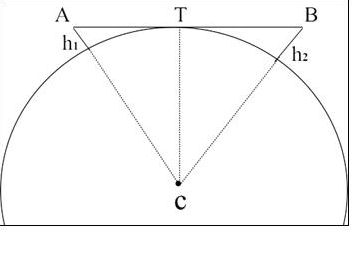
The above calculation was made with the assumption that the observer’s eye is at sea level.  Of course, the height of the observer’s eye will be several metres above sea level (say 3 – 4 m. in a yacht or small fishing vessel).  So the height of eye must obviously be taken into account and the problem now becomes as shown in the following diagram:

A represents the observer,

B represents the top of the lighthouse,

T represents the horizon,

h1 represents the observer’s height of eye (say 4m.)

h2 represents the height of the lighthouse (120m.).

So, we have  AB  =  AT + BT

To calculate the value of AB, we must first calculate the values of AT and BT.

Using the formula that we previously established for finding the distance from the top of an object to the horizon, we have:

AB  =(2rh1) + √(2rh2)

Given that r = 6367.45 Km.   h1 = 4m.   and h2 = 120m.

we have:

D = (2 x 6367.45 x h1/1000) + (2 x 6367.45 x h2/1000)  Km.

= (12734.9 x 4/1000) + (12734.9 x 120/1000)  Km.

= (12734.9 x 0.004) + (12734.9 x 0.12)  Km.

= 7.1 + 39.09 Km.

=  46.19 Km.

To convert to nautical miles, we have:

D   = 46.19 x 0.54 = 24.9 n.m.

So we can see that taking the observer’s height of eye into account makes quite a difference to the result.

Summary of formula for calculating the distance that an object will appear on the horizon taking into account height of eye:

D = (2rh1) + (2rh2)

D = (12734.9 x h1/1000) + (12734.9 x h2/1000)  Km.

Or   D = (12734.9 x h1/1000) + (12734.9 x h2/1000)  x 0.54 n.m.

 What about the height of tide?

The height of objects shown on navigational charts is the height above the level for ‘mean high water springs’ (MHWS) which is used as the chart datum for heights.  When navigating in areas where there is a large tidal range, the height of tide in relation to MHWS must be taken into account if the charted height of the object is being used in navigational calculations.  For example, in the vicinity of the Channel Islands, the height of tide at low water springs can be in the region of 7.5 metres below the level for MHWS and in such circumstances, 7.5 metres would obviously need to be added to the charted heights of objects.

(If you are a bit rusty on Pythagoras’ Theorem, you can find a brief reminder here).

Web: www.astronavigationdemystified.com

Posted in Astro Navigation Topics, Schools | Tagged , , , , | 1 Comment