Revise Pythagoras’ Theorem


If after reading some of my other posts, you feel you are a bit rusty on Pythagoras’ Theorem, here is a quick brush up for you.

 We can see in the diagram below that, in the triangle ABC, if a perpendicular is dropped from point A to side a at point D, ABC is divided into 2 smaller triangles which are both similar to ABC.


Consider triangle (i).  Since this triangle is similar to ABC, it follows that:

a÷b  =  b÷x

→  b2  =  ax    …………….(i)

Now consider triangle (ii); by similar argument:

a÷c  =  c÷y

→  c2  =  ay    …………….(ii)

Combining (i) and (ii) we get:

b2  +  c2  =  ax + ay

→  a( x + y )  =  b2  +  c2

But  a  =  x + y

→  a2 =  b2  +  c2  This is Pythagoras’ Theorem

 Simple Example


The distance from town A to town B is 48.5Km.

The distance from town B to town C is 38.25Km.

What is the distance from town C to town A?

By Pythagoras,

CA2  =  AB2 + BC2

→ CA2  =  48.52 +  38.252

=  2352.25  +  1463.06

=  3815.31

→  CA     =  √3815.31

=  61.77Km.

Therefore the distance from town C to town A is 61.77Km.

 Web: www.astronavigationdemystified.com


Posted in Astro Navigation Topics, Schools | Tagged , , , , | 3 Comments

Declination Table For Survival Use

Sun’s Declination Table constructed for use in survival situations to be used when calculating latitude from the altitude of the midday sun.

Provided by Astro Navigation Demystified (www.astronavigationdemystified.com)

The following table shows the mean values of the declination of the Sun for each day of the year over the leap year cycle.

The value of each declination is taken to 1 decimal place which is compatible with the expected accuracy of a clinometer reading.

JAN FEB MAR APR MAY JUN
1 23.1S 17.3S 7.8S 4.3 N 14.9N 22.0N
2 22.9S 17.1 S 7.4S 4.7 N 15.2N 22.1N
3 22.9S 16.8S 7.0S 5.1 N 15.5N 22.2N
4 22.8S 16.5S 6.6S 5.5 N 15.8N 22.3N
5 22.7S 16.2S 6.3S 5.8 N 16.1N 22.5N
6 22.6S 15.8S 5.8S 6.2 N 16.4N 22.6N
7 22.4S 15.6S 5.5S 6.6 N 16.6N 22.7N
8 22.3S 15.2S 5.1S 7.0 N 16.9N 22.8N
9 22.2S 14.8S 4.7S 7.3 N 17.2N 22.9N
10 22.1S 14.6S 4.3S 7.7 N 17.4N 23.0N
11 21.9S 14.3S 3.9S 8.1 N 17.7N 23.0N
12 21.8S 13.9S 3.5S 8.5 N 18.0N 23.1N
13 21.6S 13.6S 3.1S 8.8 N 18.2N 23.2N
14 21.5S 13.3S 2.8S 9.2 N 18.5N 23.2N
15 21.3S 12.9S 2.3S 9.5 N 18.7N 23.3N
16 21.1 S 12.6S 2.0S 9.9 N 19.0N 23.3N
17 20.9S 12.2S 1.6S 10.3N 19.2N 23.3N
18 20.7S 11.8 S 1.2S 10.6N 19.4N 23.4N
19 20.5S 11.6 S 0.8S 10.9N 19.6N 23.4N
20 20.3S 11.2 S 0.4S 11.3N 19.8N 23.5N
21 20.1S 10.8S 0.0 11.6N 20.1N 23.5N
22 19.8S 10.5S 0.4N 12.0N 20.3N 23.5N
23 19.6S 10.1S 0.8N 12.3N 20.4N 23.5N
24 19.4S 9.7S 1.2N 12.4N 20.6N 23.4N
25 19.2S 9.4S 1.6N 13.0N 20.8N 23.4N
26 18.8S 9.0S 2.0N 13.3N 21.0N 23.4N
27 18.6S 8.6S 2.6N 13.6N 21.2N 23.3N
28 18.4S 8.3S 2.8N 14.0N 21.4N 23.3N
29 18.1S 8.0S 3.1N 14.3N 21.5N 23.2N
30 17.8S   – 3.5N 14.6N 21.6N 23.2N
31 17.6S   – 3.8N    – 21.8N    –
JLY AUG SEP OCT NOV DEC
1 23.1N 18.1N 8.5N 2.9S 14.2S 21.7S
2 23.1N 17.9N 8.1N 3.3S 14.6S 21.8S
3 23.0N 17.6N 7.8N 3.7S 14.8S 22.0S
4 22.9N 17.4N 7.4N 4.1S 15.2S 22.1S
5 22.8N 17.1N 7.0N 4.5S 15.5S 22.3S
6 22.7N 16.8N 6.6N 4.8S 15.8S 22.4S
7 22.6N 16.6N 6.3N 5.3S 16.1S 22.5S
8 22.5N 16.3N 5.9N 5.6S 16.4S 22.6S
9 22.5N 16.0N 5.5N 6.0S 16.6S 22.7S
10 22.3N 15.7N 5.1N 6.4S 16.9S 22.8S
11 22.2N 15.4N 4.8N 6.8S 17.2S 22.9S
12 22.1N 15.1N 4.4N 7.1S 17.5S 23.0S
13 21.9N 14.8N 4.0N 7.5S 17.8S 23.1S
14 21.8N 14.5N 3.6N 7,9S 18.1S 23.1S
15 21.6N 14.2N 3.3N 8.3S 18.3S 23.2S
16 21. 5N 13.9N 2.8N 8.6S 18.6S 23.3S
17 21.3N 13.6N 2.5N 9.0S 18.8S 23.3S
18 21.1 N 13.3N 2.1N 9.4S 19.1S 23.3S
19 20.9N 13.0N 1.7N 9.7S 19.3S 23.4S
20 20.8N 12.6N 1.3N 10.1S 19.6S 23.4S
21 20.6N 12.3N 0.9N 10.5S 19.8S 23.4S
22 20.4N 12.0N 0.5N 10.8S 20.0S 23.4S
23 20.2N 11.6N 0.1N 11.2S 20.2S 23.4S
24 20.0N 11.3N 0.2S 11.5S 20.4S 23.4S
25 19.8N 10.9N 0.6S 11.8S 20.6S 23.4S
26 19.6N 10.6N 1.0S 12.2S 20.8S 23.4S
27 19.3N 10.3N 1.4S 12.6S 21.0S 23.3S
28 19.1 N 9.9N 1.8S 12.9S 21.2S 23.3S
29 18.9N 9.6N 2.1S 13.2S 21.3S 23.2S
30 18.6N 9.3N 2.6S 13.6S 21.5S 23.2S
31 18.4N 8.8N    – 13.8S    – 23.1S
Posted in Astro Navigation Topics, Survival | Tagged , , , , , | 2 Comments

How To Make A Mini-Clinometer For Survival Use

A clinometer is a simple device that can be used to measure the altitude of an object. Despite its simplicity, a clinometer provides a level of accuracy sufficient to measure angles to the nearest degree.  A ‘mini-clinometer’ as shown below, can be constructed very easily and cheaply and is small enough to stow in a ruck sack or boat emergency ‘grab bag’.  For more information click here.

Materials Required.

  1. Short wooden or plastic baton (approx. 40 cm in length).
  2. 1 drinking straw.
  3. Short piece of string.
  4. Small weight such as a fishing-line weight.
  5. A school protractor.
  6. Strong glue (suitable for sticking wood to plastic).
  7. Tacks.
  8. A piece of smoked glass (see note 3 under ‘Method of Use’ below).

Suggested Method of construction (see diagram).

  1. Glue baton onto protractor as shown in the diagram.  (Note.  If you are unable to find a protractor that is marked in the same way as the one in the diagram, simply change the numbers with an indelible pen).
  2. Glue drinking straw to top of baton as shown in the diagram.
  3. Make a plumb-line from the string and weight and attach to protractor as shown in the diagram.

Method of Use.

  1. Holding the instrument by the baton, sight the target object through the drinking straw (rather like a telescopic rifle-sight).
  2. Hold the device as steady as possible and ask a partner to read off and record the angle indicated by the plumb-line.  This will be the angle of elevation of the object above the horizon.  If you are alone, simply clamp the string against the side of the protractor with a spare finger as soon as you are lined up with the object and then read off the angle indicated by afterwards.
  3. If available, a piece of smoked glass should be used when measuring the altitude of the Sun to avoid damaging your eyesight.  This would obviously be difficult for a single person but if you are in company, ask a colleague to hold the smoked glass in front of the Sun for you.  (If a piece of manufactured smoked glass cannot be obtained, simply hold a piece of glass in the smoke of a candle or oil lamp until it is covered in a layer of smoke residue).

www.astronavigationdemystified.com

Posted in Schools, Survival | Tagged , , , , , | 2 Comments

Could the Global Positioning System Fail?

Quite apart from the local risks of defective equipment, battery failure, generator failure and short-circuits to electronic navigation equipment caused by flooding, there is a very real global risk that the GPS could be destroyed.

During periods of increased solar activity, massive amounts of material erupt from the Sun.  These eruptions are known as coronal mass ejections and when they impact with the Earth they cause disturbances to its magnetic field known as magnetic storms.  Major magnetic storms have been known to destroy electricity grids; shut down the Internet, blank out communications networks and wipe out satellite systems (including the global positioning system).  There is scientific evidence to suggest that increasing solar activity will cause major magnetic disturbances in the near future and NASA has issued a major solar storm warning for 2012.

Couple the danger of solar storms with that posed by cyber terrorists who could block GPS signals at any time, then it can easily be seen that navigators who rely solely on electronic navigation systems could be faced with serious problems.

How could seafarers navigate the oceans if the global positioning system (GPS) failed?  The answer is, they could revert to the tried and tested art of astro navigation.

web:   www.astronavigationdemystified.com

Posted in Astro Navigation Topics | Tagged , , , , , | 4 Comments

Latitude from the Midday Sun

Finding Your Latititude From The Midday Sun.

The following diagrams will help to explain how the latitude can be calculated from the Sun’s midday altitude and its declination.

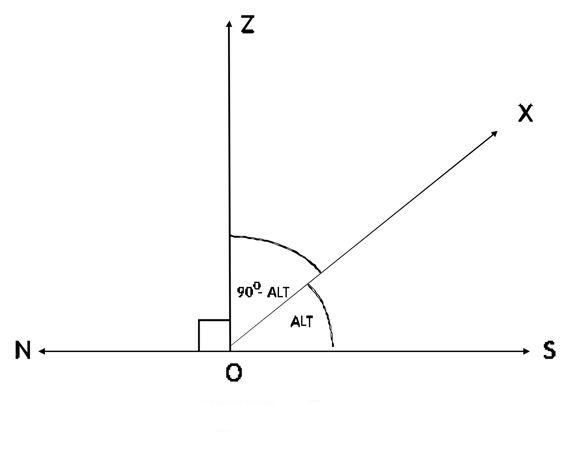
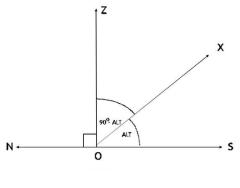
 In the following diagram ,

NOS  represents the horizon and O represents the position of the observer,

X       represents the position of the Sun,

Z         represents an imaginary position exactly above the observer so that OZ is perpendicular to NOS,

OX     represents a line from the observer to the Sun,

angle XOS    represents the altitude of the Sun at midday,

angle XOZ  equals 90o – Altitude.
Now consider the next diagram.

Imagine the Earth to be at the centre of the imaginary celestial sphere with the positions Z and X projected onto the surface of that sphere.
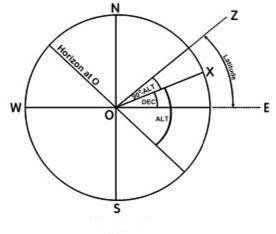
WOE  represents the projection of the Equator onto the surface of the sphere,

NOS   represents the projection of a line joining the North and South poles onto the surface of the sphere.

angle EOZ equals the latitude of the observer,

angle EOX equals the declination of the Sun,

angle XOZ         equals 90o – Altitude

Therefore, Lat. = Declination + (90o-Altitude).

In the case above, latitude and declination are in the same hemisphere but the latitude is greater than the declination. There are two other cases to consider:

In the next diagram, latitude and declination are in the same hemisphere but declination is greater than latitude.
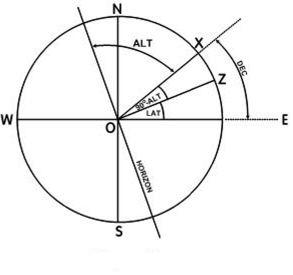
In this case:

Declination  =  (90o – Altitude) + Latitude

therefore Lat.  =  Dec. – (90o – Alt.)

In the next case, latitude and declination are in opposite hemispheres as shown in this diagram:
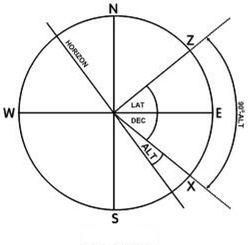
In this case:

Latitude + Declination  =  (90o – Altitude)

therefore, Lat.  =  (90o – Alt.) – Dec.

We can summarise the rules for the three cases as follows:

(i)                Latitude and declination same names and latitude greater than declination:

LAT  =  DEC + (90o – ALT)

(ii)             Latitude and declination same names and declination greater than latitude:

LAT  =  DEC – (90o – ALT)

(iii)           Latitude and declination contrary names:

LAT  =  (90o – ALT) – DEC

Examples:

1.   Using rule (i)

Scenario:  True altitude at midday: 72o 30’.1     Sun’s declination: 23o 21’.3

LAT  =  DEC + (90o – ALT) (rule i)

= 23o 21’.3 + (90o – 72o 30’.1)

= 23o 21’.3 + 17o 29’.9

= 40o 51’.2 S.

2.   Using rule (ii)

Scenario:  True altitude at midday: 6941’.3      Sun’s declination: 23o 25’.6

LAT  =  DEC – (90o – ALT) (rule ii)

= 23o 25’.6 – (90o – 6941’.3)

= 23o 25’.6 – 20o 18’.7

= 3o 06’.9 N.

3.   Using rule (iii)

Scenario:  True altitude at midday: 8048’.01    Sun’s declination: 2o 59’.0

LAT = (90o – ALT) – DEC (rule iii)

= (90– 8048’.01) – 2o 59’.0

      = 9 11’.99 – 2o 59’.0 = 6 o 12’.9N.

web: www.astronavigationdemystified.com

Posted in Astro Navigation Topics, Schools | Tagged , , , | 2 Comments